Sunday 22nd June 1986
7:06pm
31 Manor Road, Streetly

‘Nooooooooooooooo!!!!!’
‘Has that been allowed?’
The words of my family were easy to hear from the kitchen of 31 Manor Road. I was kneeling in front of a cupboard, having been asked to fetch some biscuits. We – that is me, my Mom and my brothers Paul and Gareth – were watching the 1986 World Cup quarter-final between England and Argentina. The game was on a knife-edge, with England holding their own against an Argentinean side boasting the greatest player in the world, a certain Diego Maradona. I was extremely nervous, and the day before I had expressed my fears to my Dad. His response: ‘No problem! We won’t lose to them’, but as the game approached on that Sunday evening, my anxiousness returned.
A month earlier, I wouldn’t have felt that way. As a seven-year-old, my interest in football hadn’t gone beyond kicking a ball about in the garden. There are some photos that exist of me doing a cheeky backheel as a five-year-old outside my Nan and Grandad’s caravan in Rhyl, wearing what suspiciously looks like Wolves colours (I have no idea why), but generally I was simply too young to appreciate the game. ‘Match of the Day’ was shown every Saturday night after my bedtime, while major tournaments had passed me by. There is probably a good chance that I watched some of the action from the 1982 World Cup, but chances are I would have been in the garden or lying in a cardboard box pretending to be a dog for most of the time (I’m not joking). Your concentration span is not at its height when you’re 3, so a 90 minute football match would have been too much for me. But even if I had sat there and watched a game or two, I simply had no memory of it whatsoever.
In fact, as a very young child, football to me was that sport where people died. The footage of the Bradford fire and the Heysel Stadium disaster – both of which had taken place in May 1985 – had been immensely harrowing. Although my family had tried to protect me from the tragedies, it was impossible to escape the dreadful scenes. The beautiful game was frankly lost on me at that point.
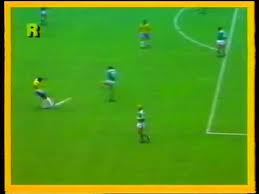
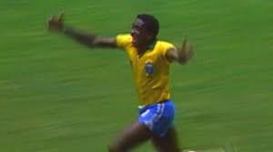
But then along came 1986, and everything would change. First of all, I watched the FA Cup Final with my Dad, cheering Everton on in their ultimately unsuccessful attempt to prevent Liverpool doing the double. Despite the result, the game had piqued my interest, and as soon as the World Cup began three weeks later, I slowly began to be hooked. Everything about the tournament awoke my senses – the vibrant colours of the sun-drenched stadia reflected in the fuzzy satellite pictures, the commentators who sounded like they were indeed 5,000 miles away as their words were relayed through crackily telephone lines into my home, Gaz’s Mexico 86 Panini album which taught me so much about the players and their dodgy haircuts, and the football itself. A lot of the games took place late at night, so I missed quite a few of the group matches, including all of England’s opening games, but the action that I did see was sublime. From Denmark’s dashing attacking play to Josimar’s cracker for Brazil against Northern Ireland – a goal and celebration that launched a hundred wannabe copycat efforts in my school playground – it was a tournament full of excitement and spectacle, and I was mesmerised.
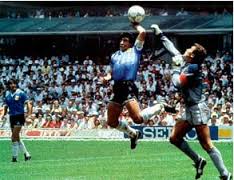
But the most dramatic moment of the championship would take place as I kneeled in my Mom’s kitchen on that midsummer Sunday evening. Aware that I had missed something important when I heard my family’s cries, I grabbed the box of biscuits and rushed back into the living room. The ball was in the England net and my brothers were apoplectic, convinced that some sort of handball had taken place. The England players that I had quickly grown to idolise were jabbing at their arms, trying to get the attention of Ali Bin Nasser, the Tunisian referee, but their complaints were being ignored. When the high-tech replays came in from three different sides of the ground, they all showed the same thing: a handball – an obvious handball from Mr Maradona. In fairness to the referee, Barry Davies who was commentating for the BBC also didn’t spot the offence at first. ‘They’re appealing for offside … The England players protesting to the referee … At what point was he offside? Or was it a use of the hand that England are complaining about? Well certainly his arm was up … but the goal stands.’
In retrospect, although Maradona had blatantly cheated, England should have prevented the goal going in anyway. Maradona was allowed to beat Glenn Hoddle on the edge of the box too easily and his attempted one-two with Jorge Valdano should have been prevented by Steve Hodge who, instead of knocking a ball back to Peter Shilton, looped the ball up into the air towards goal, thereby enabling Maradona to run onto it. But how on earth did he beat Shilton to the ball? The height difference between them was eight inches, but Shilton got nowhere near. Even in 1986, Shilton was looking as though age was catching up with him, and he really should have got to the ball first. Yes, it was an illegal goal, but it was a soft, soft goal.
But that was of no consolation to us inside 31 Manor Road. We were totally deflated, feeling robbed by a decision which was extraordinarily poor for a World Cup quarter-final. However, there was still a match to be won and England had to put it behind them. Hard, but they had to try to do it. Little did they – or we – know what was soon to come.
When Maradona got the ball ten yards into his own half, there seemed to be little concern. But a quick turn and a drag back with his left foot made him beat both Peter Beardsley and Peter Reid and advance into the England half. There he took advantage of the space ahead of him. He used his left foot all the way, controlling the ball on the heavy, bobbly pitch, all the time keeping hold of it as though it were tied to his foot with string. He took on Terry Butcher and beat him easily, then used his strength to run through Terry Fenwick’s attempts to chop him down – a so-called defender who made Vinnie Jones look like Dame Vera Lynn. Now it was Maradona against Shilton, and with a dummy and a touch of his left foot, Maradona knocked the ball past him and shrugged off Butcher to stretch for the ball and knock it into the unguarded net. In just 14 touches, Maradona had beaten the entirety of the English defence and had produced a moment of genius that was nearer to art than football. It was the greatest goal that any of us had ever seen, but coming after the handball, it was particularly tough. The fact that the two goals had been scored within four minutes of each other – one the most shocking ever seen in a World Cup, the other the most stupendous – took the wind out of all of our sails. The scene in our living room echoed that of thousands of others around the country – that of shock, anger and bewilderment, but with a grudging acknowledgement that we had witnessed something very special.
Our chances of progressing had surely now gone, and our mood was made worse when a new close-up replay was shown of Maradona’s first goal, clearly showing that he’d punched the ball into the net. We hadn’t yet heard of the phrase ‘Hand of God’ – that would come later – but the anger inside Manor Road was palpable. Something may have been mentioned about the Falklands, while Barry Davies made a comment about referees being used in big matches ‘from the Third World’. Oh dear.
But England only had themselves to blame. They’d been too workmanlike, too dull. A few chances were starting to be created, but it was all too little, too late. The only light relief came from Barry Davies calling the Argentinean goalkeeper PUMPPPP-EE-DOO, instead of Pumpido which everyone else said. This attempt to try and make a point about the correct pronunciation was a trademark of Davies’ commentary, and it would quietly keep me amused for years to come.
With 16 minutes left, England took off Trevor Steven and brought on John Barnes, who was sporting a rather tremendous afro. Davies asked, ‘From where is the inspiration to come’, and four minutes later, it would come from Barnes. Receiving the ball just outside the left-hand corner of the 18 yard box, he sold a couple of dummies, got past two defenders and made it to the byline. He put a beautiful cross into the area where England players were starting to line up – and it was Gary Lineker who got there first, planting a downward header into the back of PUMPPPP-EE-DOO’s goal.
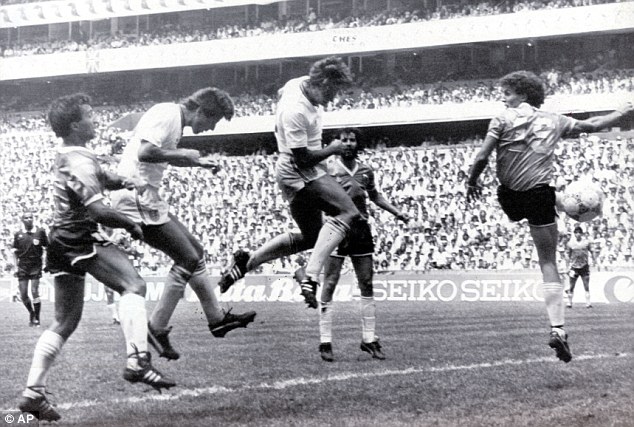
‘YESSSSSSS!!!!!’ We flew off the sofa as we cheered England’s unexpected goal. Suddenly there was a chink of daylight. It didn’t matter that immediately after the restart, Argentina hit the inside of the post through Carlos Tapia, who found more space in the England defence than at a Right Said Fred convention – we were back in the game, and now England were beginning to press forward. ‘Give the ball to Barnes’, we screamed, recognising that he was the only England player showing an ounce of creativity. With three minutes left, we got our wish. Barnes got the ball from Beardsley wide on the left, toyed with another couple of defenders, before putting in ‘a peach of a cross’ (B. Davies) for Lineker to head into the net. The sofa was rocking again as we celebrated England’s equalizer. There was only one problem, however – the ball hadn’t gone in. As we looked up, we saw that the ball had somehow ended up near the photographers behind the goal, and the referee was signalling a corner. We had no idea what had happened as we stood there with our hands on our heads, but the replays showed that as Lineker dived for the ball, the Argentine defender Julio Olarticoechea had made a fantastic backward header, flicking the ball away from Lineker just as he was about to put it away. ‘Twas gutting – that’s for certain, and it would be England’s last chance. The final whistle went shortly afterwards and England were going home.
Such a disappointment could easily have put me off football, but of course it didn’t. I would go on to join the rest of my family in supporting Aston Villa from the following season onwards, so I would frequently get used to disappointment. The World Cup had cast a dye within me and I was now a fully-fledged football supporter. To my family, who I would drive mad with my obsession for years to come, I can only apologise.
 Andy Evans
I was trying to do homework and watch that Argentina game. Burst into tears upon the Hand of God and gave up. Teacher gave me an extension on my essay deadline the next day – top bloke!
He sounds like a cool guy!