2002 World Cup

Friday 7th June 2002
1:15 pm
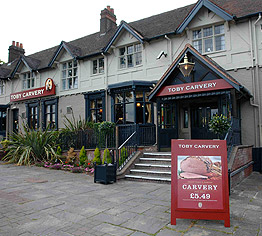
Halifax PLC, Preston
halifax

There are certain things that are best avoided during the daytime – alcohol, television, anything to do with Heart FM (best avoided at any time, actually) – and for a brief period in 2002, I added ‘watching football’ to that list also.

I began the World Cup with such high hopes as well. With the tournament being held in Japan and South Korea, the matches were shown on British TV at either 7:30am, 9:30am or 12:30pm. As a 23-year-old night owl who used to stay up until the middle of the night listening to music or watching old films, the World Cup was in danger of passing me by without so much as a flicker, but I was determined to catch as many games as I could. The summer of 1998 was now a distant memory. Four years on, I was in a far more settled place, although still a bit fragile at times, and was ready to enjoy a World Cup again.

And I started well. On the first Saturday of the World Cup, I stumbled out of my bed just before 7:30am to watch the 1-1 draw between the Republic of Ireland and Cameroon… at least, I think that’s what the score was – I was so damn tired. Still, I felt a real sense of achievement. It didn’t matter that my bedroom was right next to the lounge in the apartment that I was renting in Preston, and only took four or five footsteps to get from one room to the other, I had done it. I felt like Edmund Hillary.

So it’s just such a shame that it was pretty much the only 7:30 game that I saw in the whole tournament – the draw of my comfy bed taking precedence from that moment on. Before long, I would be missing the 9:30 games too, and the World Cup would start to disappear from before my very eyes. How deluded I was.

Mind you, there was a lot of stuff going on during that time. Having graduated from university in 2000, I made the decision to stay in Preston. Part of the reason was that I felt settled there, having made a lot of friends at the church I was attending, and also the fact that Mike and Andrea, two of my best friends from uni, had decided to remain there. But the main reason why I stayed up north was because in 1999 four of us from church had formed a band – Kev on vocals and rhythm guitar, Phil on drums and Mark on lead guitar. I was on bass, having been inspired to take it up a few years earlier after watching John Deacon, who I always thought was the coolest member of Queen. It was also much easier to play than the six string guitar, but we won’t mention that. Anyway, we were initially called Acquiesce, after the Oasis song, but unfortunately we had to change our name to Aquiesce (minus the ‘c’) after Mark’s brother spelled the name wrong when he was registering a website for us. But nevertheless, it wasn’t long before we realised that there was a chemistry between the four of us, and we therefore decided to make a go of things. Thus, I stayed in Preston and got myself a part-time job at the local Littlewoods call centre, where I took phone calls from (mainly) women ordering items from clothing catalogues. This was the crazy rock ‘n’ roll playboy lifestyle that we were living at the time.

We eventually changed our name from Aquiesce to Blindride at the end of the year. We got a bit tired of people being unable to pronounce it when we were introduced on stage (‘Would you please welcome onto the stage, Acq… Acq… ACQUIENCESES!!!), plus it was a sign of us trying to take things more seriously. We started gigging around Preston from the start of 2001, instead of just playing in churches or at Christian events – a decision which nearly gave our youth leader of the time a stroke as he told us that we were ‘wasting our talents’. Still, we were ably supported by our girlfriends (we only had one each, I must point that out) and church friends who made regular trips to The Adelphi and The Corner Club to cheer us on. Friends of friends were also invited along, and they seemed to like us too. By the summer of 2002, we were getting a bit of a name for ourselves, and it was all very nice and exciting.

ADELPHI

Those adjectives could not be used for the paid job I had at the time, though. After being made redundant from Littlewoods and working a seven-month finite contract at an agricultural company, I found myself working for the Halifax at one of their major admin offices in the centre of town. Ah, the Halifax – ‘the bank who gives you Extra’. If by ‘Extra’, they meant stress, pain, bitchiness and a feeling of desperation akin to someone on Death Row, then, yes, it was a pretty accurate description. As someone who normally looks for the good in people, I just couldn’t understand the obvious dislike from some of the most senior members of staff for the temps who worked there. Most of us had just completed degrees, so maybe that was the reason – a feeling that they were stuck in a rut whereas we weren’t – but none of us temping there were anything other than friendly and hard-working. We were treated like complete crap and the place was an utter hellhole. I hated it there.

A few weeks after starting work there, I moved into a rented apartment with Kev and Phil, where I would struggle to make it from my bedroom to the lounge for early World Cup matches. The flat was on the same road as the Halifax office, so you would think that there would be no problems getting to work on time – and on most days there weren’t – but occasionally my lack of punctuality would rear its ugly head, and thereby allow Annie to rear hers – a horrible witch of a woman who insisted on belittling us temps at any given opportunity. She was just one of a number of people who made our lives a misery, and any relief from their treatment was most welcome.

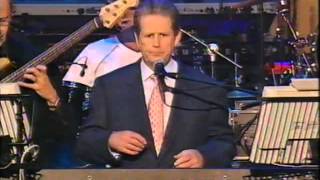
So the events of June 2002 came along at just the right time. The start of the World Cup coincided with the Queen’s Golden Jubilee. For the first time in a long time, it was acceptable to wave a Union Jack out of your window and the country’s nationalistic fervour was for once healthy and lovely. The highlight of the celebrations was the fantastic concert from Buckingham Palace, featuring my musical hero, Brian Wilson. Poor old Brian looked a little confused to be there, but he was great, and his comeback from personal problems was very inspirational to me at the time. Plus a four-day weekend meant time away from the Halifax, so thank you Ma’am.
brian

On the same weekend, England started their World Cup campaign – a 9:30 kick-off that I did manage to get up for. I later wished I hadn’t bothered as we struggled to a 1-1 draw against Sweden. That result, coupled with Argentina’s 1-0 win over Nigeria (we were in that year’s ‘Group of Death’) and Sweden’s subsequent 2-1 victory against the Nigerians meant that England had to beat Argentina on the Friday lunchtime to realistically stay in the World Cup. The build-up to the game was so intense that across the country, firms and offices made allowances for their staff to watch the game. Incredibly, so did the Halifax, showing that they did have a little bit of humanity hidden underneath their dark souls.

On the day of the game, I made it into work at 8:30 – for some reason I wasn’t late that day – and sat down with about 20 work colleagues to watch the game just before the kick-off at 12:30. Although the temps had had problems with some of the managers (and other wannabe managers), the younger members of staff were generally nice and could see what was going on there. One of the lads there – David – was extremely cool, with an unkempt beard and a penchant for indie music. His attitude was at odds with the company’s ‘pull the ladder up and sod the rest’ culture, and we got on quite well. He was among the group sat down for the game, and the atmosphere in the room was, dare I say, quite pleasant.

I too was attempting to grow a beard during that time. There was no real reason for doing it – I just fancied one for a while – and so for the duration of the World Cup, I had a beard in the style of Abraham Lincoln – aka no moustache. Unfortunately, it wasn’t quite as impressive as his, and was ginger, patchy and incredibly itchy. I did manage to go to the local hairdressers next to work for a ‘beard trim’, but how the barber managed not to laugh in my face is beyond me. At least he didn’t say ‘What beard?’ – I couldn’t have stood the shame.

dictator-beard

And so to the match. As it kicked off, John Motson made a few references to the fact that the game was taking place at lunchtime. It was indeed unusual and a nice way to break up the Halifax stress, but he did seem to be over-egging the cake somewhat by consistently talking about it. But maybe that was his way of getting through the game as it was incredibly nail-biting. As Gabriel Batistuta and Kily González went close for Argentina, and Michael Owen hit the post for England, some people bit their fingers, others screamed, while I sat there and slowly stroked my beard like a Bond villain. I think it was partly to check that it was still there and hadn’t done a runner to avoid the tension of the game.

But on the stroke of half-time came a breakthrough. A Paul Scholes pass found Owen in the box, who turned and fell under a challenge from Mauricio Pochettino (later to become manager of Southampton and now Spurs). The replay showed that Owen clearly took another of his customary dives, but referee Pierluigi Collina (he of the bald head and scary eyes) pointed straight to the spot. Penalty.

Blimey, this beard is feeling a bit itchy…

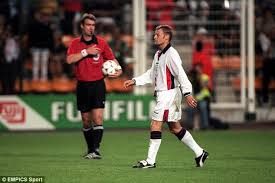
Up stepped David Beckham and the tension in the room increased even more. Everyone knew that this was his chance of redemption for four years before. He was now England captain and doing a superb job, but that sending off in Saint-Etienne still hung over him. He needed to score.

Ok, this is starting to get ridiculous now. Scratch, scratch, scratch…

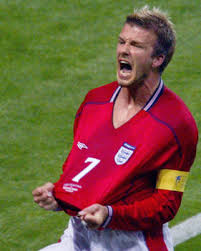
Beckham waited for what seemed like an age, and then ran up and smashed the penalty into the centre of the net. 1-0. The way he struck the ball and his impassioned celebrations afterwards exorcised all of that frustration, anger and emotion, and offices around the country joined in with him. We all jumped up and went mad, but not quite as crazy as my bearded friend David, who screamed ‘YESSSSSSSSSSSSSSSSSSSS!!!’ continually, before making a couple of peace signs to calm himself down and slowly sitting back down in his seat.
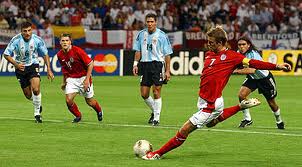
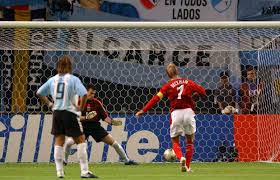
beckham 1 beckham 2 beckham 3

Half-time came and went, with everyone dashing for either a kettle or a toilet, and then we were back in position for the second half. England started well, with Owen and Beckham putting shots past the post, and Scholes and substitute Teddy Sheringham both volleying thunderbolts which forced Pablo Cavallero into making a couple of decent saves. But then the pressure started. Argentina moved into the ascendency, and mounted wave after wave of attacks on the England goal. David Seaman – complete with ridiculous ponytail – made a couple of great saves, including a brilliant stop from Pochettino, while normally unsung players like Nicky Butt and Trevor Sinclair performed with bravery and plenty of heart, keeping the Argentineans out.

I’m shaving this damn thing off as soon I get home…

When the final whistle went, we exploded with joy. The ghosts of 1986 and 1998 had been expunged, the Halifax for once seemed like a nice place to work and England were back in the World Cup. But of course, this optimism wouldn’t last. England would be knocked out in the quarter-final by Brazil, leading to a mass taking down of the flags which had by now become dirty and raggedy. The Halifax would soon return to its one-upmanship and nastiness, and within a month I had left, joining a much happier office at Preston Magistrates Court.

As for the band, well, it sadly wouldn’t last for me. By the next summer, I was living back in Birmingham, trying to get my head around a number of personal upheavals and wondering what the hell had just happened. It wasn’t as bad as the summer of 1998, but it came flipping close. However, I wouldn’t change a thing. My Preston days were both good and bad, but it’s the good stuff that lasts longest in your memory, and I look back at that time with immense fondness.

I never grew another beard, though.

7573933208_990635777a_o

1998 World Cup

Tuesday 30th June 1998
10:34 pm
The Parson & Clerk, Streetly

depressed man

It’s often easy to look back at events with rose-tinted glasses. The brain has a certain knack of filtering out the bad and replacing it with a somewhat untrue version of what actually happened. But when your mind is unable to do that about a particular time, you know that things were really, really bad back then. That is definitely true of the summer of 1998.

It’s hard to know how it started. The previous year had been terrific for me. I had passed all my ‘A’ Levels in 1997 and had joined the University of Central Lancashire (AKA Preston University) in the September of that year. I settled into my studies (English and Journalism) and made a huge amount of friends, both in my halls and through the Christian Union. I was (dare I say it) quite popular and I really enjoyed meeting new people and exploring a completely new town and its sounds, sights and nightclubs.

But at the end of the academic year, in April 1998, something started to go wrong. I was hit by a wave of anxiety that I just could not shift. My thoughts became panic-stricken and my emotional state started to deteriorate. It got to the point where I was scared to get out of bed in the morning, as I knew that the whole cycle would start all over again. It wasn’t long before I realised that I was going through some sort of breakdown. It lasted for pretty much the whole summer and it was undoubtedly the worst time of my life.

Me being me, I didn’t tell people about it. I just didn’t want to worry people and tried to cure myself through praying, hoping and gritting my teeth. But it was the wrong decision. I was back at Manor Road for the summer, and it wasn’t long before my family could tell that something was going on, but no matter how much they tried to help me – and they were brilliant – I just couldn’t shake the condition off. I also wasn’t helped by my summer job at a factory in Walsall, which occupied me physically but not mentally, leaving me with too much time to ponder my thoughts. The constant rollickings from pumped-up machismo types didn’t help either.

So it was in this context that the 1998 World Cup took place for me, and it overshadowed the tournament. That’s not to say that I didn’t watch and enjoy games, and it did give me a welcome respite from all the other stuff going on. Following England’s 2-0 victory against Tunisia in their first group game, they were due to play two evening games during the next week, against Romania (on the Monday) and Colombia (on the Friday). I was working from 2–10 pm during that week, and would miss the games. The manager of our section was a smiley but fierce character, who seemed to like me but few other people. Therefore, we weren’t allowed to have radios on in our part of the factory. But I kept an ear out on the Monday night, hoping to find out the Romania score via a distant radio, and trying to ignore the ear plugs I was wearing and the fact that I was being deafened by numerous amounts of machinery. Unsurprisingly, I completely missed the score, a 2-1 defeat. However, our manager used to go home early on a Friday, so an old radio was found for the Colombia game and placed in our section. We still couldn’t hear the damn thing properly, but were able to figure out the two times that England scored, a 2-0 victory which just about put them through to the second round. But no matter how welcome this news was, the effect of it was short-lived. Although the nation was caught up in another World Cup campaign, it was impossible for me to get truly excited about it. When going through an emotional trauma, it envelopes everything else going on in one’s life. Football just did not matter that much any more, not at a time like this.

One of the few highlights of the summer, though, was catching up with old school mates, including James, my best friend since the age of 3, and Andrew, who we called – and still call – by his surname, Norton. After England qualified for the next stage, we arranged to watch the forthcoming game against Argentina at a local pub in Streetly, The Parson & Clerk. The Parson had been a haunt of mine prior to me going to University, with me spending a very happy afternoon there following my final ‘A’ Level exam. It was a local pub with a slightly ‘spit and sawdust’ layout in those days, but it was always friendly enough and we were looking forward to meeting up there.

parson and clerk

The game was kicking off at 8pm (I was working a 6am – 2pm shift that week) so we got there 10 minutes beforehand. Naively, we imagined that we would be able to get a seat, but the large area beneath the big screen was packed to capacity. After buying a drink, we went to the back of the seated area and stood up to watch the game.

The first half was probably the most extraordinary of any England game I have ever seen. After five minutes, David Seaman needlessly brought down Diego Simeone as he ran away from goal. Gabriel Batistuta scored from the spot, although we all cheered in the pub at first as it looked as though Seaman had pushed it around the post. Four minutes later, though, and we were cheering for the right reason. Michael Owen picked up a loose ball and ran in on goal. The whole pub rose en masse, thereby blocking our view, but there was a huge roar seconds later when England were awarded a penalty. The replay showed that Owen had basically ran past Roberto Ayala, and then had fallen over. It was a clear dive, but the penalty was given. The people in the seated area remained standing as Alan Shearer stepped up to take the penalty. A brief pause and then huge celebrations followed. We joined in, knowing (or should I say presuming) that Shearer had scored.

Then came one of the two moments that everyone remembers about the game – the Michael Owen wonder goal. When he picked the ball from David Beckham’s pass, his first touch to bring the ball down was fantastic and he was on his way. Unfortunately, so were the crowd in the pub, who again stood up and blocked our view. We had no idea what was going on, and it was only after the eruption of cheers when we actually saw on the replay how good his goal was. A really special moment – shame we missed it.

After Paul Scholes missed a sitter to make it 3-1, Argentina forced a free-kick in stoppage time. Juan Sebastián Verón shaped up to shoot, but instead passed it to Javier Zanetti, who had broken free from the England wall. He smashed the ball into the net, and England’s hard work had been undone by a brilliant move.

2-2 at half-time, and although Argentina’s fantastic equalizer had rendered the Parson stunned, the quality of the first 45 minutes had left the fans in good spirits. There was as yet no hint of what was to come.

beckham

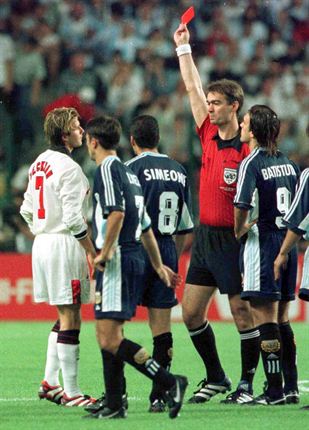
The problems began when Beckham was sent off for his petulant kick out at Simone. With the hindsight of 16 years, it looks a harsh decision – although Beckham was daft to do what he did – but in the pub it was an outrage. England were now a man down and had to try to cling on against one of the best teams in the world. It was unbearably tense, and as time went on and the alcohol flowed, the crowd started to turn. It started with a chant of ‘NO SURRENDER TO THE IRA’ to the tune of ‘Give Me Oil In My Lamp’, which made the three of us feel decidedly uncomfortable. Then the shouts of ‘STREETLY’ and ‘KINGSTANDING’ began. Kingstanding is the next town to Streetly and there has always been a perceived rivalry between the two places. Normally only schoolchildren were interested in such things, but yet here we were in a pub with 40-year-olds who were shouting their allegiances to either place. It was freaky, and although things were still seemingly fine, a tinderbox was starting to kindle.

This wasn’t helped when Sol Campbell’s header was disallowed with nine minutes to go, after Shearer decided that it would be a good idea to blatantly elbow Argentina’s goalkeeper Carlos Roa in the face. Again, the crowd’s reaction was biased, and the tension increased within the room. We knew that a rare chance had gone begging, all because of Shearer’s idiocy. England were playing bravely, but just about hanging on in there. We were praying for penalties. When they eventually came, the room let out a sigh of relief. England had managed to keep out the Argentineans and now it was down to who could keep their nerve. The punters at the Parson were nervous too, and thankfully remained in their seats.

After Sergio Berti and Shearer scored their penalties (the first time I’d seen England score that night), David Seaman dived to his left and saved Hernán Crespo’s penalty. The pub erupted, but we still had four more penalties to take. Paul Ince was the next man to step up, and he missed too, in a carbon copy of Crespo’s effort. We couldn’t believe it – the advantage had been lost – and we cringed as Veron, Marcelo Gallardo and Ayala put their penalties away, and cheered as Paul Merson and Owen did likewise with theirs.

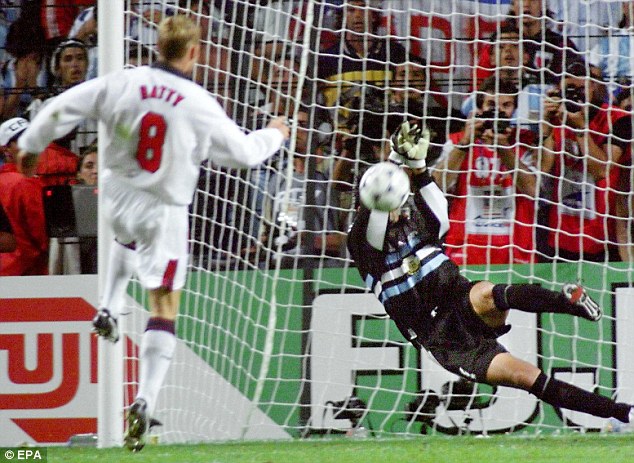
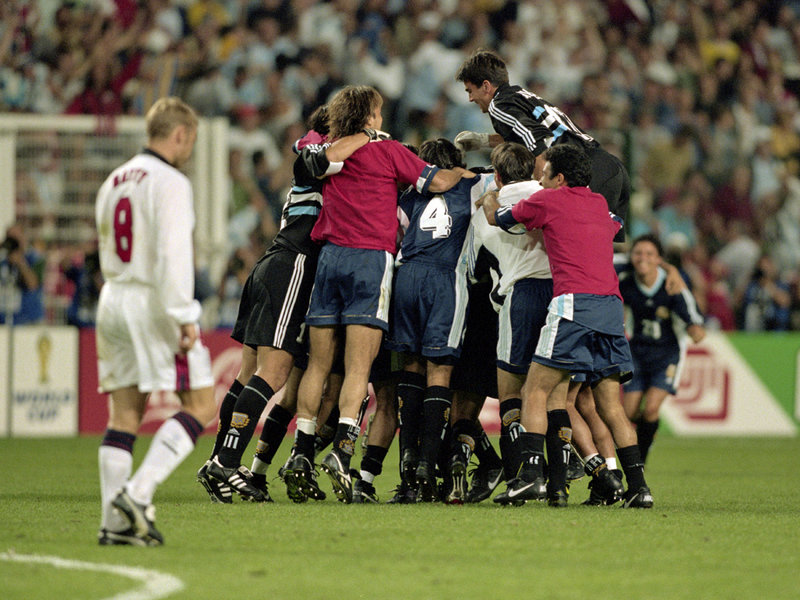
There was one penalty left and the pub groaned as David Batty walked up – a man who had never taken a spot kick before. Beckham probably would have taken it, but he was off the pitch, and Batty needed our support. A cry of ‘COME ON’ came from the pub as he stepped back to take it, while Brian Moore (commentating for ITV) bizarrely asked Kevin Keegan, ‘Do you back him to score? Quickly – yes or no?’ Keegan answered ‘Yes!’ but was wrong. Batty hit his penalty too close to Roa and he saved it easily. That was it – it was all over. As the Argentineans celebrated, James, Norton and I stood there, completely stunned. After such a brave effort, we were out.

batty 1 batty 3 batty 2

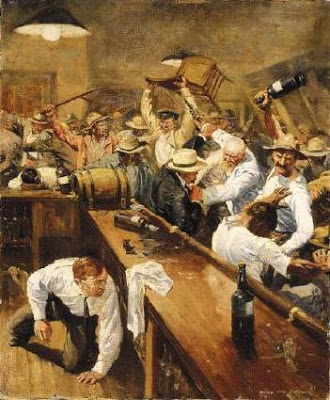
It was at this point that James quietly said to us, ‘It’s gonna kick off in here. Let’s move to the bar. You mark my words, it’s gonna kick off in here.’ I must admit that I hadn’t spotted anything. All the tension following Beckham’s dismissal seemed to have been dissipated by the penalty drama, but Norton and I decided to take him at his word and we moved to the bar. Thank God that we did. As a man stood up to stretch in the middle of the seated area, he was told to sit down by the bloke behind him. The standing man turned round and said ‘***K OFF!’ and before we knew it, all hell had broken loose. The two men started grappling with each other and their friends quickly joined in. Within seconds, beer was flying and chairs were being thrown as other people inexplicably got involved in the fight. Two bouncers came wading in from the pub door – any excuse for a punch-up – and seemed to be smacking anyone in their way, whether they were involved in the fight or not, while a terrified female voice came out from behind the bar, screaming for someone to turn the TV off.

fight

It was like something from a cowboy film, but it was very real. As the three of us watched from our safe vantage point of the bar, the whole of the seating area were suddenly involved in the mother of all punch-ups, and it was extremely scary. Eventually some staff came out and kicked everybody out of the pub, leaving Norton, James and I at the bar, slowly drinking our pints and apologising to an elderly Canadian couple who were touring around England. They seemed genuinely fascinated with what was going on, particularly with the women who were now joining in with the fighting outside, but for us it was a horrible experience. After waiting for a break in proceedings, which came half an hour later when the police finally arrived, we crept out of the pub and made our way home. At one point, I looked back to see one of the bouncers standing in the middle of Chester Road repeatedly kicking a man as he lay on the ground, which pretty much said everything. When I reached home, I told my Mom what had happened and said that it was a relief that England had been knocked out when they had. If they had gone further in the World Cup and had been knocked out in the semi-final (for instance), God knows what would have happened.

The reaction to the Argentina defeat seemed in keeping with the trauma that hit me during the summer of 1998. Thankfully, by the time I started university again in September, I had recovered, although the experience left me with an emotional fragility that would take years to shift. It really was a wretched time and I was pleased to see the back of it, and if any event summed up what took place during that summer, it was the events of that night at The Parson & Clerk.

1994 World Cup

Sunday 10th July 1994
6:33 pm
5 Tudor Grove, Streetly

sting

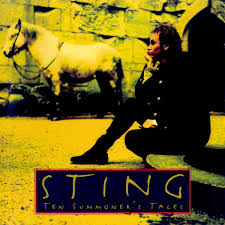
1994 – ah, those were halcyon days. I was 15, with a centre-parting, a spotty forehead and a penchant for blushing at any given moment. Mind you, things weren’t all bad. It was probably the only time in my life where I could say that I was slim, although I didn’t think that at all at the time. My teenage antenna was at its most alert, and I was soaking up everything to do with culture, particularly music. The year before, in the spring of 1993, I heard ‘If I Ever Lose My Faith In You’ by Sting on Top of the Pops. It only took four minutes, but suddenly I was a different person. The atmospheric chords, the beautiful lyrics and the triumphant chorus hit me like a ton of lead. It felt like coming home in a bizarre way – a song that touched every happy nerve within me – and would open the doors for a love affair with music which would never leave me. The song would also come to sum up my life in those mid-teen, mid 90s years.

During my years at the Comp (the local nickname for my secondary school), there were three girls above all others that I was infatuated with. In order to spare my blushes after 20 years, and to avoid any awkward moments on Facebook, I will simply refer to them as Girls 1, 2 and 3. During Years 8 and 9 (1991–1993), I was crazy about Girl 1 – a gorgeous girl who reportedly had broken the hearts of a string of boyfriends. I had managed to make her laugh a couple of times when a few of us from school went to see Robin Hood: Prince of Thieves about 18 months earlier, which at the time was the best feeling in the world for a 13-year-old. But it was a crush from afar. The very idea that I would try to ask her out was ludicrous. I was far too shy (albeit with an eccentric streak) and struggled with my self-esteem like most teenagers do. It would have been suicide. But I was happy. I could admire her from a distance (not in a creepy way, you understand) and think of her when I listened to the love songs which I was suddenly hearing in an altogether different way.

But by 1994, Girl 1 had been replaced in my affections by Girls 2 and 3. Now, having a crush on two girls might give the impression that I had become some kind of Hugh Heffner character, but rest assured, dear reader – I hadn’t. One of the girls had been in a lot of my classes until the summer of 1993 when we had to pick our options, but afterwards we were in completely different lessons, apart from Maths. I don’t think she was trying to avoid me, although you never know. Anyway, the result was that a brief acquaintance was replaced by no interaction whatsoever. There was, however, one occasion when she spoke to me when giving out some work in Maths, which had me grinning from ear to ear like a demented cat. She must have wondered what drugs I was on. All she said was ‘Is this your work, Andrew?’ What else was she going to say? Oh, how very embarrassing and tragic.

The other girl was shy, which appealed to me. She would laugh at the ludicrous way me and my mates would answer the register in Chemistry lessons (the titles of Madness songs being used instead of ‘Yes Sir’), and seemed extremely lovely and approachable. But naturally, the notion of asking out either girl again seemed nonsensical and I was determined that it was not going to happen.

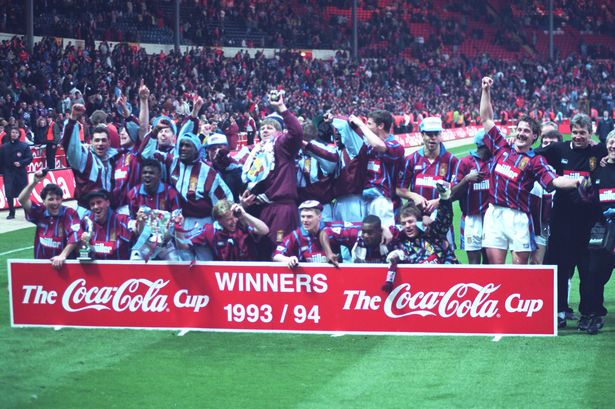
Anyway, what all of this lovelorn stuff proves is that football no longer had the number one place in my affections by 1994. I still loved the game and experienced one of the best moments of my life in March of that year when I went to Wembley to see Villa beat Man Utd 3-1 in the League Cup Final, but music and forlorn crushes on unattainable girls had started to take over. Therefore, although I was excited about the forthcoming World Cup in America, it couldn’t really compare with how I had felt four years earlier.

1994 villa

Part of the reason for this was the fact that England had failed to qualify. In a group with Holland, Poland, Norway, Turkey and San Marino, we struggled throughout and after a 2-0 defeat to the Dutch in Rotterdam, we were out. The best chance for a British qualifier had in fact been Wales, who needed to beat Romania in their final qualifying match to get to the US. My Welsh roots were fully in gear when Wales were awarded a penalty with half an hour remaining and the match finely poised at 1-1. However, Paul Bodin crashed the penalty against the crossbar, Romania went and scored a winner and the nation my Nan described as ‘our homeland’ were out.

However, the Republic of Ireland had managed to qualify, whose team had more than its fair share of non-nationals within it. All of their players played in the top two divisions in England, and quite a few of them were (whisper it) English, who many felt were representing the Republic in order to fast-track their way to international football. Of course, this was a simplistic explanation, and some of the players had clearly always felt Irish – John Sheridan had played for the Republic from youth level onwards, despite having been born in England – but there is no doubt that some of the players in the squad had been ‘opportunistic’ (shall we say) in their choice of country.

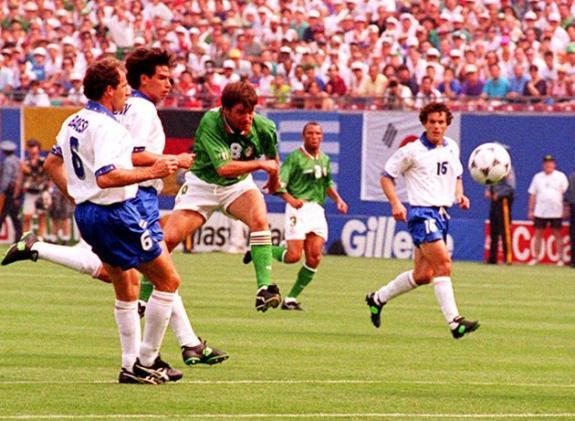
The same was true for the fans. My mates Todd and Paul from school suddenly declared themselves as having an interest in the Irish team, and bought tops to reinforce this natural order of events. All very dodgy. For my part, I had nothing against Ireland – after all, several of the squad were Villa players, including Paul McGrath, Steve Staunton and Andy Townsend – but I wasn’t about to ditch England for them. However, I was happy to cheer them on in the World Cup, and was jumping around my living room when Ray Houghton (another Villa player) scored the winner in their unlikely 1-0 win against Italy.

ray-houghton-goal-v-italy-94

Ireland’s feat, although brilliant, was not that unusual for a World Cup which was strangely exciting. Previously unheralded teams such as Nigeria, Romania and Bulgaria were setting the tournament alight, with the latter teams boasting two of the stars of the competition in the forms of Gheorghe Hagi and Hristo Stoichkov. The football on show was creative and the matches were hard to predict, with shocks being the order of the day. And more bizarrely of all, England’s failure to qualify added to the excitement. For the first time, I could watch a World Cup without any pressure or nerves. I could just sit back and immerse myself in the sporting drama, and it was strangely pleasant.

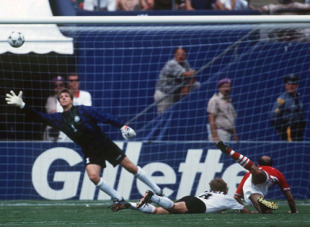
But by the time of the quarter-finals, the unexpected nature of the World Cup was expected to come to an end, particularly for the clash between the holders Germany and Bulgaria. Although the German squad was aging, with many players past their 1986 and 1990 best, they were still the overwhelming favourites to beat the sparkling Bulgarians. On the day of the game, I was at my Auntie and Uncle’s house for my cousin Nathan’s 12th birthday party, so as we ate copious amounts of sandwiches and jelly and ice cream, and played the obligatory game or two of cricket in the garden, my family were largely ignoring events from New Jersey.

IvanovMik

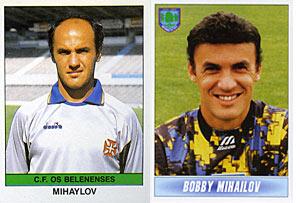
But in the subtle way that these things often happen, by the start of the second half we found ourselves as a family around the TV in the living room, watching the game. One of the major talking points of the tournament had been the somewhat eccentric appearance of some of the Bulgarians. Their goalkeeper, Borislav Mihailov, famously wore a wig, while their defender Trifon Ivanov was nicknamed ‘The Bulgarian Wolf’ for his unkempt beard, greasy-looking mullet and his permanently tired expression which seemed to suggest that he’d spent the last 48 hours on an alcohol binge. There was also a balding central midfielder, Yordan Letchkov, who looked more like a 48-year-old civil servant than a 27-year-old footballer. However distracting these players might have been, though, they still didn’t manage to stop Germany from taking the lead two minutes after half-time. Jürgen Klinsmann found his way into the penalty area and took a typical tumble after a challenge from Letchkov. Yes, he was ever so slightly caught, but his fall was akin to being charged with 4,000 volts. The referee’s decision to award a penalty was greeted with derision by us all.

‘GET UP!!!’ we shouted, but it was to no avail – unsurprisingly, the referee was unable to hear us from across the Atlantic. Lothar Matthäus ignored us too as he stepped up and put the penalty away. Typical Germany – not playing particularly well, but somehow in the lead, and they weren’t going to let it slip now. They never did, especially against underdogs. It was all over surely.

We carried on watching the game, albeit with a little less interest than before. The Germans kept pressing forward, with Andreas Möller hitting the post with an absolute rocket of a shot. The rebound was put in by Rudi Völler, but thankfully – and correctly – he was judged to be offside. Bulgaria were hanging on by their fingernails, Germany had one eye on the semi-finals and we were thinking of going back into the garden again.

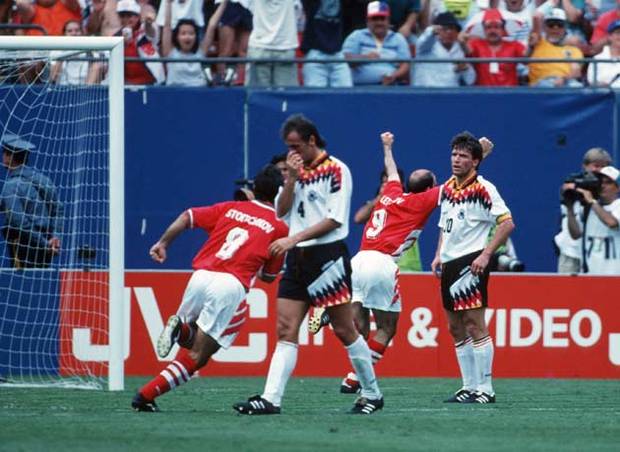
But with 15 minutes remaining came a lifeline. Stoichkov tangled with Möller just outside the German box and a free-kick was awarded to Bulgaria. Stoichkov picked himself up and clipped a perfect free-kick into the top left-hand corner, leaving goalkeeper Bodo Illgner stranded. We leapt off the sofa, delighted that the underdogs were back in the game.

Suddenly there was a change. From the restart, Bulgaria smelled a chance and pressed forward. Germany were clearly rattled. We’d never seen them like this before. They were always the master of the comeback – the sign of a truly great side, of course – but now they were giving the ball away and playing well below their own high standards. Bulgaria forced a corner, and from the resulting breakdown, the ball found its way to Zlatko Yankov (no sniggering) on the right-hand side between the edge of the German box and the touchline. He cut inside, wriggled past a challenge from Thomas Berthold and crossed into the penalty area. Enter our friend, the civil servant, Letchkov, who rose like a salmon in front of Thomas Haessler and magnificently smashed a classic diving header past Illgner. Bulgaria had scored twice in three minutes and were 2-1 ahead.

letchkov 1 letchkov 2 letchkov 3

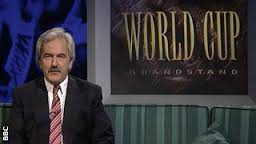
‘LETCHKOV! YES! OH, LOOK AT THIS! THEY’RE IN FRONT!’ screamed John Motson as we danced around our room. We were unable to contain our excitement as we tried to get our heads around what was happening. Germany never went out at the quarter-final stage and had reached the final of three of the past four tournaments (1986 and 1990 World Cup, Euro 88), but now they were just a few minutes away from going out – to Bulgaria. It was incredible, and as the minutes ticked by, we were holding our breath, desperate that our newly adopted country would hold on and cause a massive upset.

And they did it. 13 minutes later, we were dancing around the room again. What a moment it was. Even 20 years later, people still remember that match and particularly Letchkov’s goal. It summed up what was an unexpectedly brilliant World Cup.

As for the romance situation, I never did ask those girls out, although I did become very good friends with Girl 2 over the course of the next 12 months, which only served to complicate matters even more. Unrequited love set to a Britpop soundtrack – fantastic and heartbreaking all at the same time. Ah, they were great days – but I wouldn’t have them back.


1990 World Cup

Sunday 1st July 1990
9:38pm
31 Manor Road
, Streetly

des

‘Let’s wind Mom up!!’

It was a cruel suggestion, but it made my brothers and I giggle with anticipation. We were watching the 1990 World Cup quarter-final between England and Cameroon. It was rare for the three of us to be together watching football, as Paul had been at Bangor University for two years, but he was now back home for the summer, and the three of us therefore began to hatch a plan.

The four years between Mexico 86 and Italia 90 had been all about football, football, football for me – with a bit of Five Star thrown in for good measure. I had become a soccer nut – every Christmas and birthday saw my room filled up with Shoot! and Roy of the Rovers annuals, as well as Aston Villa memorabilia of all shapes and sizes. The whole childhood Star Wars thing had totally passed me by – I was obsessed with football. When I wasn’t playing it in the garden – commentating on my career as I did so (the neighbours thought I had Tourette’s) – I was playing football games on the ZX Spectrum or reading old books and programmes that were stored under Gareth’s bed and had been forgotten about for years. All of this absorption had given me an encyclopaedic knowledge of league champions and FA Cup Final winners, which led to me being put on display at the dos of friends and family to answer questions put to me from a succession of grown-ups. Villa Park had also become a second home as my Dad and I watched Villa get relegated in 1987, promoted a year later, before the 1989/90 season where they miraculously came close to winning the league, eventually finishing second to Liverpool.

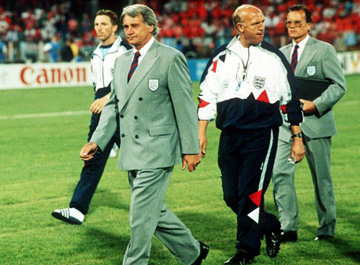
So as you can imagine, I was looking forward to the 1990 World Cup eagerly. But for a time it seemed as though I was in the minority. Hooliganism was still in its pomp and football attendances were down. Stadiums were decrepit and the Hillsborough Disaster of the previous year had been a horrific, dreadful, final straw. Added to the fact that England manager Bobby Robson had announced his resignation – albeit after the forthcoming tournament – following the most horrendous abuse from newspapers of all description, and there wasn’t much to smile about.

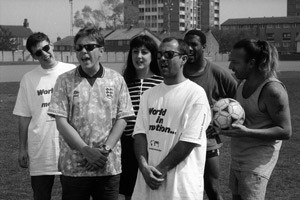
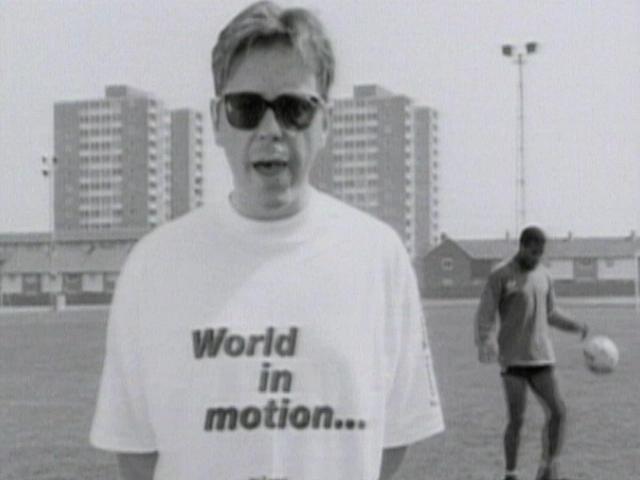
The idea, then, that a bunch of Mancunian druggies would change the image of the game was more than unlikely. But that’s exactly what happened. Unbelievably, the usually stick-in-the-mud Football Association had asked New Order to provide the official song for England’s World Cup campaign. The song they came up with – ‘World in Motion’ – was a reflection of the changing culture of the time: an alternative acid-house tune that had more to do with Ecstasy pills than Jimmy Hill. I absolutely loved it – the song that is – as did the rest of the nation. The playground of Manor Primary School, where I was plodding through my final few weeks before starting secondary school in the September, echoed to the sound of the song every lunchtime (well, possibly once or twice, but I’m trying to be nostalgic and wistful here), and even non-football fans were caught up in its brilliance. And as for John Barnes’ rap, well, that was just a thing of beauty…

new order worldinmotion

But as England’s World Cup campaign started, all of the excitement was well and truly snuffed out. They struggled through their group, with a dismal 1-1 draw against Republic of Ireland followed by a goalless draw against Holland. We then stumbled our way to a 1-0 victory against Egypt, and amazingly finished top of our group. The only bright spark was the England shell suit, which had been sported so wonderfully by England’s miserable looking bunch of substitutes and coaching staff. Everyone wanted one – they looked spectacular (at the time) – so when my Mom told me that she would buy me one, I was thrilled. We didn’t have a lot of money, so such a purchase was going to be very special. However, I should have known something was afoot when, instead of going to Debenhams or John Lewis, we headed for Walsall market. Yes, the shell suit in question was not quite ‘official’, shall we say. I think it lasted about three washes.

italia 90 shellsuit

The last 16 game against Belgium provided one of the tensest moments I had so far experienced as a football fan, with David Platt scoring his infamous winner in the last minute of extra time. As you can imagine, we went nuts – a Villa player scoring such a vital goal for our country, it was just great. However, England had been lucky. Belgium had outplayed us, hitting the woodwork on a couple of occasions, before Platt stepped off the bench to save the day. One thing was for certain, they couldn’t play like that during the quarter-final. The only problem, of course, is that they went and did exactly that.

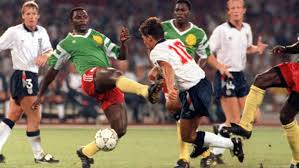
Cameroon were lighting up the tournament with their brand of carefree attacking football (and random, hilarious bouts of violence). They had shocked the world by beating the holders Argentina in the opening game, and had beaten both Romania and Columbia too, thanks to two goals in each match from their secret weapon, Roger Milla, a 38-year-old substitute who many suspected to be at least twice that age. His habit of coming off the bench to devastating consequences were by now legendary, as was his fantastic corner-flag wiggle which he would do whenever he scored. The Indomitable Lions were no pushovers, so it was odd to read the papers of the time suggesting that they would be just that on the eve of England meeting them in the last 8.

It’s such a shame that the England side seemed to believe all that the press were saying, because as the game kicked off, they just never got going. Cameroon were immediately pressing for the jugular, with Peter Shilton (now 84) being forced into a series of good saves. It was tense stuff. So when David Platt headed England into the lead after 25 minutes, we all let out a cheer which was akin to ‘Thank goodness for that’. It was relief rather than joy. England were ahead and normal service would now be resumed.

Fat chance. Cameroon just continued where they left off, playing fantastic one-touch football that had a beautiful rhythm to it. Although England went in at half-time 1-0 ahead, they were clinging on somewhat. What Cameroon needed – and England didn’t – was a bit of Milla magic, and when he came on at the start of the second half, he completely changed the game. Suddenly Cameroon had direction to go with their skill and enthusiasm, and they were pressing and pressing towards the England goal.

And this was the time when my Mom started to panic. You see, my lovely Mom isn’t too good when it comes to tense moments during a football match. She spent the entire period of extra time during the 1966 World Cup Final hiding in the kitchen, which was the place she always went to when things were not going the way of Villa or England. She spent a lot of time in the kitchen. Anyway, she began to really get restless as Cameroon got more and more dangerous. In the 61st minute, all of their pressure came to fruition when Milla got into the England box and was brought down by Gazza (as he was now known). The resulting penalty was converted by Emmanuel Kundé and Cameroon were level.

My Mom would last another four minutes in the living room. Cameroon were now dominant – buoyed by their equalizer – and a one-two between Eugène Ekeke and Milla totally split the English defence in half. Milla weighted his ball perfectly and Ekeke ran on to it and slotted the ball past Shilton. 2-1 to Cameroon, and completely deserved it was, too. As for my Mom, she couldn’t take any more.

‘Oh, I knew it!! What’s the matter with them?! They always do this!’ she exclaimed as she rushed past us into the kitchen. Paul, Gaz and I just sat there as our World Cup dream was fading away. England were simply playing terribly, and there seemed to be no way forward. They just couldn’t cope with the Milla magic. We were surely on our way home.

But then, with eight minutes to go, came a lifeline. As a Stuart Pearce free-kick was headed out of Cameroon’s area, the loose ball came back towards Gary Lineker who fell down under the challenge of Benjamin Massing, a huge centre-back whose claim to fame was that he fouled the Argentinean winger Claudio Caniggia with such force in the opening game that his own boot flew off, thereby confirming him as a legend in the Evans household. However, this time was different. He didn’t seem to have made any contact with Lineker, but down our man went anyway.

Lineker brought down

‘PENALTY!!’ we all shouted as the referee pointed to the spot. Mom was delighted, but remained in the kitchen as she couldn’t take the tension of watching the penalty being taken. This is where our plan came into action. The three of us decided to trick Mom by agreeing that, if Lineker scored, we would give the impression to Mom that he had missed. It was very cruel but very funny, and we waited for Lineker to take his kick. He duly ran up and put it past Thomas N’Kono into the top-right hand corner of the net. 2-2.

‘OH NOOOOOOOOOOOOOOOOO!’ We shouted as the rest of the nation were cheering. We were probably the only England fans who greeted Lineker’s penalty with that reaction, and it certainly surprised Mom who came running in to see what had happened.

‘Only joking. He scored. It’s 2-2.’

‘Oh, I don’t believe you. Fancy doing that!’ My Mom was smiling, though. It was a little joke, but it had been done with a huge amount of heart. We were delighted that we’d equalised and that Mom could now join us for the rest of the game.

The incident would be the pivotal moment in England’s World Cup campaign. They suddenly seemed to wake up to how near they were to going out of the competition, and when the final whistle went a few minutes later, Bobby Robson appeared to be telling them the same thing. When extra-time started, they were a different side. They were now in charge and on the stroke of half-time, Lineker broke free again. N’Kono came out to him, with Massing chasing, and he went down. It didn’t look like there was much contact again, but the referee duly pointed to the penalty spot.

‘YESSSSSSSSSSSSSSS!’ This time, the reaction was different as Lineker blasted his penalty into the net, straight down the middle. My Mom was in the living room this time, and we were able to share in the country’s celebrations, which is what we did again 15 minutes later when the final whistle went. England had scraped through, rather undeservedly, but they had done so nonetheless, and were now in the semi-final.

We all know the story from this point. Parker’s deflection, Lineker’s equalizer, Gazza’s tears, ‘Have a word with him!’ and the eventual heartbreaking exit to West Germany on penalties, but it was the first penalty by Lineker in that Cameroon match that changed everything. Without it, England would have gone home miserably without putting up much of a fight, but after the semi-final defeat in Turin, they returned home as heroes, with football fully established as part of popular culture once again. The game hasn’t looked back since.

As for my Mom, she still spends more time in the kitchen during football matches than in front of the TV, but we wouldn’t have it any other way – and she has now forgiven us, just about.

1986 World Cup

Sunday 22nd June 1986
7:06pm
31 Manor Road, Streetly

mexico 86

‘Nooooooooooooooo!!!!!’

‘Has that been allowed?’

The words of my family were easy to hear from the kitchen of 31 Manor Road. I was kneeling in front of a cupboard, having been asked to fetch some biscuits. We – that is me, my Mom and my brothers Paul and Gareth – were watching the 1986 World Cup quarter-final between England and Argentina. The game was on a knife-edge, with England holding their own against an Argentinean side boasting the greatest player in the world, a certain Diego Maradona. I was extremely nervous, and the day before I had expressed my fears to my Dad. His response: ‘No problem! We won’t lose to them’, but as the game approached on that Sunday evening, my anxiousness returned.

A month earlier, I wouldn’t have felt that way. As a seven-year-old, my interest in football hadn’t gone beyond kicking a ball about in the garden. There are some photos that exist of me doing a cheeky backheel as a five-year-old outside my Nan and Grandad’s caravan in Rhyl, wearing what suspiciously looks like Wolves colours (I have no idea why), but generally I was simply too young to appreciate the game. ‘Match of the Day’ was shown every Saturday night after my bedtime, while major tournaments had passed me by. There is probably a good chance that I watched some of the action from the 1982 World Cup, but chances are I would have been in the garden or lying in a cardboard box pretending to be a dog for most of the time (I’m not joking). Your concentration span is not at its height when you’re 3, so a 90 minute football match would have been too much for me. But even if I had sat there and watched a game or two, I simply had no memory of it whatsoever.

In fact, as a very young child, football to me was that sport where people died. The footage of the Bradford fire and the Heysel Stadium disaster – both of which had taken place in May 1985 – had been immensely harrowing. Although my family had tried to protect me from the tragedies, it was impossible to escape the dreadful scenes. The beautiful game was frankly lost on me at that point.

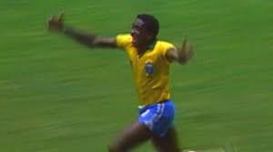
But then along came 1986, and everything would change. First of all, I watched the FA Cup Final with my Dad, cheering Everton on in their ultimately unsuccessful attempt to prevent Liverpool doing the double. Despite the result, the game had piqued my interest, and as soon as the World Cup began three weeks later, I slowly began to be hooked. Everything about the tournament awoke my senses – the vibrant colours of the sun-drenched stadia reflected in the fuzzy satellite pictures, the commentators who sounded like they were indeed 5,000 miles away as their words were relayed through crackily telephone lines into my home, Gaz’s Mexico 86 Panini album which taught me so much about the players and their dodgy haircuts, and the football itself. A lot of the games took place late at night, so I missed quite a few of the group matches, including all of England’s opening games, but the action that I did see was sublime. From Denmark’s dashing attacking play to Josimar’s cracker for Brazil against Northern Ireland – a goal and celebration that launched a hundred wannabe copycat efforts in my school playground – it was a tournament full of excitement and spectacle, and I was mesmerised.

josimar 1Josimar 2

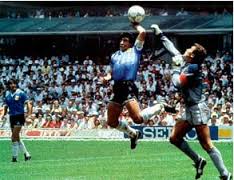
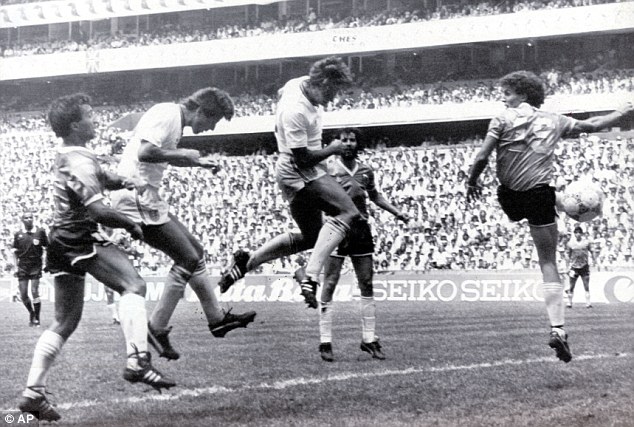
But the most dramatic moment of the championship would take place as I kneeled in my Mom’s kitchen on that midsummer Sunday evening. Aware that I had missed something important when I heard my family’s cries, I grabbed the box of biscuits and rushed back into the living room. The ball was in the England net and my brothers were apoplectic, convinced that some sort of handball had taken place. The England players that I had quickly grown to idolise were jabbing at their arms, trying to get the attention of Ali Bin Nasser, the Tunisian referee, but their complaints were being ignored. When the high-tech replays came in from three different sides of the ground, they all showed the same thing: a handball – an obvious handball from Mr Maradona. In fairness to the referee, Barry Davies who was commentating for the BBC also didn’t spot the offence at first. ‘They’re appealing for offside … The England players protesting to the referee … At what point was he offside? Or was it a use of the hand that England are complaining about? Well certainly his arm was up … but the goal stands.’

In retrospect, although Maradona had blatantly cheated, England should have prevented the goal going in anyway. Maradona was allowed to beat Glenn Hoddle on the edge of the box too easily and his attempted one-two with Jorge Valdano should have been prevented by Steve Hodge who, instead of knocking a ball back to Peter Shilton, looped the ball up into the air towards goal, thereby enabling Maradona to run onto it. But how on earth did he beat Shilton to the ball? The height difference between them was eight inches, but Shilton got nowhere near. Even in 1986, Shilton was looking as though age was catching up with him, and he really should have got to the ball first. Yes, it was an illegal goal, but it was a soft, soft goal.

Maradona

But that was of no consolation to us inside 31 Manor Road. We were totally deflated, feeling robbed by a decision which was extraordinarily poor for a World Cup quarter-final. However, there was still a match to be won and England had to put it behind them. Hard, but they had to try to do it. Little did they – or we – know what was soon to come.

When Maradona got the ball ten yards into his own half, there seemed to be little concern. But a quick turn and a drag back with his left foot made him beat both Peter Beardsley and Peter Reid and advance into the England half. There he took advantage of the space ahead of him. He used his left foot all the way, controlling the ball on the heavy, bobbly pitch, all the time keeping hold of it as though it were tied to his foot with string. He took on Terry Butcher and beat him easily, then used his strength to run through Terry Fenwick’s attempts to chop him down – a so-called defender who made Vinnie Jones look like Dame Vera Lynn. Now it was Maradona against Shilton, and with a dummy and a touch of his left foot, Maradona knocked the ball past him and shrugged off Butcher to stretch for the ball and knock it into the unguarded net. In just 14 touches, Maradona had beaten the entirety of the English defence and had produced a moment of genius that was nearer to art than football. It was the greatest goal that any of us had ever seen, but coming after the handball, it was particularly tough. The fact that the two goals had been scored within four minutes of each other – one the most shocking ever seen in a World Cup, the other the most stupendous – took the wind out of all of our sails. The scene in our living room echoed that of thousands of others around the country – that of shock, anger and bewilderment, but with a grudging acknowledgement that we had witnessed something very special.

Our chances of progressing had surely now gone, and our mood was made worse when a new close-up replay was shown of Maradona’s first goal, clearly showing that he’d punched the ball into the net. We hadn’t yet heard of the phrase ‘Hand of God’ – that would come later – but the anger inside Manor Road was palpable. Something may have been mentioned about the Falklands, while Barry Davies made a comment about referees being used in big matches ‘from the Third World’. Oh dear.

But England only had themselves to blame. They’d been too workmanlike, too dull. A few chances were starting to be created, but it was all too little, too late. The only light relief came from Barry Davies calling the Argentinean goalkeeper PUMPPPP-EE-DOO, instead of Pumpido which everyone else said. This attempt to try and make a point about the correct pronunciation was a trademark of Davies’ commentary, and it would quietly keep me amused for years to come.

With 16 minutes left, England took off Trevor Steven and brought on John Barnes, who was sporting a rather tremendous afro. Davies asked, ‘From where is the inspiration to come’, and four minutes later, it would come from Barnes. Receiving the ball just outside the left-hand corner of the 18 yard box, he sold a couple of dummies, got past two defenders and made it to the byline. He put a beautiful cross into the area where England players were starting to line up – and it was Gary Lineker who got there first, planting a downward header into the back of PUMPPPP-EE-DOO’s goal.

Lineker

‘YESSSSSSS!!!!!’ We flew off the sofa as we cheered England’s unexpected goal. Suddenly there was a chink of daylight. It didn’t matter that immediately after the restart, Argentina hit the inside of the post through Carlos Tapia, who found more space in the England defence than at a Right Said Fred convention – we were back in the game, and now England were beginning to press forward. ‘Give the ball to Barnes’, we screamed, recognising that he was the only England player showing an ounce of creativity. With three minutes left, we got our wish. Barnes got the ball from Beardsley wide on the left, toyed with another couple of defenders, before putting in ‘a peach of a cross’ (B. Davies) for Lineker to head into the net. The sofa was rocking again as we celebrated England’s equalizer. There was only one problem, however – the ball hadn’t gone in. As we looked up, we saw that the ball had somehow ended up near the photographers behind the goal, and the referee was signalling a corner. We had no idea what had happened as we stood there with our hands on our heads, but the replays showed that as Lineker dived for the ball, the Argentine defender Julio Olarticoechea had made a fantastic backward header, flicking the ball away from Lineker just as he was about to put it away. ‘Twas gutting – that’s for certain, and it would be England’s last chance. The final whistle went shortly afterwards and England were going home.

Such a disappointment could easily have put me off football, but of course it didn’t. I would go on to join the rest of my family in supporting Aston Villa from the following season onwards, so I would frequently get used to disappointment. The World Cup had cast a dye within me and I was now a fully-fledged football supporter. To my family, who I would drive mad with my obsession for years to come, I can only apologise.

The Villa Times column – Issue 7

This is the second column about my book, Heart of a Lion – a nostalgic look at the decade between 1986 and 1996 and all the shenanigans of being a young Villa supporter during that time. Heart of a Lion is my first book and I’m about 23,000 words into my first draft, so there’s still a long way to go, but it’s been interesting to see how a book can almost write
itself as you start to get some momentum. The initial plan was to base the book around 25 significant games during my first 25 years as a fan. At first, this seemed like a good idea. The memory of watching the 2000 FA Cup semi-final in a packed student house in Preston – trying to ignore a so-called ‘close friend’ who was shouting ‘Miss!’ at the TV screen as Gareth Barry prepared to take his penalty during the shoot-out – is still fresh in my mind, as is the despair of watching that throw-in disappear under Peter Enckelman’s foot on the night when we were thrashed by the Blues in 2002.

But it is as a child that your memories are that much richer, that much more evocative. This would explain why I can barely remember anything about Villa’s UEFA Cup campaign in 1997/98, when we reached the quarter-finals, but can recall a 0-0 draw with Barnsley ten years earlier during our second division days with clarity. As the first draft got under way, it therefore seemed sensible to concentrate on those first ten years of my time as a
supporter – the sights, sounds and smells that are so much of part of a child’s life if he or she is a football fan. Therefore, the book will feature 20 games from that period.

So how do you go about choosing 20 matches for a book? It would be obvious to go with the really massive games, and yes, some of those will be in there. No game before or since has been quite as emotional as the Tranmere semi-final in 1994, for instance, even though I was on watching it on TV at the time. But, as the Bolton and Blues matches stated earlier prove, all fans have their own memories of watching games that are personal to them, and I’m no exception. Looking back, there were some extraordinary and unique moments
during those ten years – from seeing a Villa fan being deliberately run over by a police horse after the last game of the 1988/89 season against Coventry – highlighting a certain attitude from the police towards football supporters at the time – to buying a ticket from a fan for a home game against Bolton in 1995, only to discover – once inside Villa Park – that the seat number stated on the ticket didn’t exist (I had unknowingly bought a fake ticket but amazingly it had got me inside the ground).

All football fans have experiences like these – moments that other people wouldn’t bat an eyelid about, but which are important to the individual fan. Those quirky incidents that make every supporter’s journey with their club an exclusive one, a special one. Maybe we should all write books. Actually, don’t do that. I wouldn’t want the market to be flooded, after all…

My first column for The Villa Times – Issue 6

Well, let’s begin at the beginning, shall we? I’m Andy Evans – a 34-year-old Villa fan
currently living in Bletchley in Milton Keynes, but I was born with claret and blue blood. Growing up in Sutton Coldfield – Streetly, to be precise – there was going to be no other team for me; plus, my family had been Villa supporters since the turn of the century, so even if I’d wanted to support another team they wouldn’t have let me. Thankfully, I had better sense than that.

After falling in love with football following the 1986 Mexico World Cup, I quickly became obsessed with all things Villa related, and eagerly awaited the 1986/87 campaign where I could cheer on my newly discovered team. Little was I to know that the season would be one of the worst in Villa’s history. I should have suspected something when I went to my first game against Norwich on 20th September and saw Villa capitulate to a 4-1 defeat. In less time than it took Simon Stainrod to grow his tremendous mullet (possibly), Villa had gone from European Champions to relegation fodder, and it was no surprise when they finished bottom at the end of the season.

Bizarrely, though, I look upon that season as a blessing. As a football fan, you need to learn as quickly as possible that things will rarely go your way – if ever – and that times will often be tough. The worst season that Villa have ever had during my time as a supporter was my first season, so it was a horrible but necessary baptism of fire – and surely things could only get better after that…

The answer to that of course is yes, but it came a bit close at times. In fact, being a Villa supporter in the ten years between 1986 and 1996 meant that you spent most of the time on the edge of your seat. I mean, just look at what happened to Villa during that time:
relegated in 1987, promoted in 1988, nearly relegated in 1989, nearly champions in 1990, nearly relegated in 1991, nearly champions in 1993, League Cup winners in 1994, nearly relegated in 1995 and League Cup winners in 1996. Throw in a few European campaigns (Inter Milan in 1990 springs to mind for some reason), one or two extraordinary results (6-2 against Everton in 1989 and 5-2 at White Hart Lane on the day of the 1992 Grand
National) and the fact that those years coincided with my childhood, and you have an eventful and evocative decade in which to have been a supporter.

Since then, I have been to University in Preston, lived briefly in Manchester (the least said about that, the better) and moved back to Streetly, before relocating to Bletchley in 2006 where I now work as a freelance writer and editor. But my love for the Villa has remained as strong as ever. I might not be able to go to as many games as I used to (geography and
finance tends to get in the way of such things) but I make sure I get to Villa Park at least once a season to cheer them on. After all, once a Villa fan, always a Villa fan.

But the memories of that decade between the mid 80s and 90s remain as strong as ever, so last year I decided to write a book about those halcyon days. The book is called Heart of a Lion, which seems to say it all really, and it looks at what it was like to be a football fan – and particularly a Villa fan – during that time, looking at 20 games which cover the period. So far I am 20,000 words into the book, so it is still ongoing. This monthly column will therefore be a progress report into how the book is going, as well as being a nostalgic trip into a time which is still remembered by many Villa fans. I hope you will enjoy it.