Sunday 10th July 1994
6:33 pm
5 Tudor Grove, Streetly
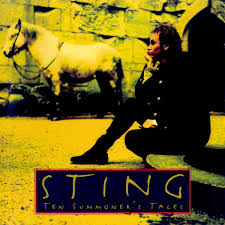
1994 – ah, those were halcyon days. I was 15, with a centre-parting, a spotty forehead and a penchant for blushing at any given moment. Mind you, things weren’t all bad. It was probably the only time in my life where I could say that I was slim, although I didn’t think that at all at the time. My teenage antenna was at its most alert, and I was soaking up everything to do with culture, particularly music. The year before, in the spring of 1993, I heard ‘If I Ever Lose My Faith In You’ by Sting on Top of the Pops. It only took four minutes, but suddenly I was a different person. The atmospheric chords, the beautiful lyrics and the triumphant chorus hit me like a ton of lead. It felt like coming home in a bizarre way – a song that touched every happy nerve within me – and would open the doors for a love affair with music which would never leave me. The song would also come to sum up my life in those mid-teen, mid 90s years.
During my years at the Comp (the local nickname for my secondary school), there were three girls above all others that I was infatuated with. In order to spare my blushes after 20 years, and to avoid any awkward moments on Facebook, I will simply refer to them as Girls 1, 2 and 3. During Years 8 and 9 (1991–1993), I was crazy about Girl 1 – a gorgeous girl who reportedly had broken the hearts of a string of boyfriends. I had managed to make her laugh a couple of times when a few of us from school went to see Robin Hood: Prince of Thieves about 18 months earlier, which at the time was the best feeling in the world for a 13-year-old. But it was a crush from afar. The very idea that I would try to ask her out was ludicrous. I was far too shy (albeit with an eccentric streak) and struggled with my self-esteem like most teenagers do. It would have been suicide. But I was happy. I could admire her from a distance (not in a creepy way, you understand) and think of her when I listened to the love songs which I was suddenly hearing in an altogether different way.
But by 1994, Girl 1 had been replaced in my affections by Girls 2 and 3. Now, having a crush on two girls might give the impression that I had become some kind of Hugh Heffner character, but rest assured, dear reader – I hadn’t. One of the girls had been in a lot of my classes until the summer of 1993 when we had to pick our options, but afterwards we were in completely different lessons, apart from Maths. I don’t think she was trying to avoid me, although you never know. Anyway, the result was that a brief acquaintance was replaced by no interaction whatsoever. There was, however, one occasion when she spoke to me when giving out some work in Maths, which had me grinning from ear to ear like a demented cat. She must have wondered what drugs I was on. All she said was ‘Is this your work, Andrew?’ What else was she going to say? Oh, how very embarrassing and tragic.
The other girl was shy, which appealed to me. She would laugh at the ludicrous way me and my mates would answer the register in Chemistry lessons (the titles of Madness songs being used instead of ‘Yes Sir’), and seemed extremely lovely and approachable. But naturally, the notion of asking out either girl again seemed nonsensical and I was determined that it was not going to happen.
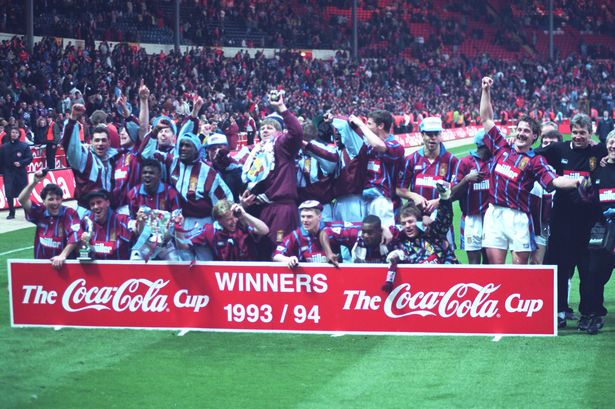
Anyway, what all of this lovelorn stuff proves is that football no longer had the number one place in my affections by 1994. I still loved the game and experienced one of the best moments of my life in March of that year when I went to Wembley to see Villa beat Man Utd 3-1 in the League Cup Final, but music and forlorn crushes on unattainable girls had started to take over. Therefore, although I was excited about the forthcoming World Cup in America, it couldn’t really compare with how I had felt four years earlier.
Part of the reason for this was the fact that England had failed to qualify. In a group with Holland, Poland, Norway, Turkey and San Marino, we struggled throughout and after a 2-0 defeat to the Dutch in Rotterdam, we were out. The best chance for a British qualifier had in fact been Wales, who needed to beat Romania in their final qualifying match to get to the US. My Welsh roots were fully in gear when Wales were awarded a penalty with half an hour remaining and the match finely poised at 1-1. However, Paul Bodin crashed the penalty against the crossbar, Romania went and scored a winner and the nation my Nan described as ‘our homeland’ were out.
However, the Republic of Ireland had managed to qualify, whose team had more than its fair share of non-nationals within it. All of their players played in the top two divisions in England, and quite a few of them were (whisper it) English, who many felt were representing the Republic in order to fast-track their way to international football. Of course, this was a simplistic explanation, and some of the players had clearly always felt Irish – John Sheridan had played for the Republic from youth level onwards, despite having been born in England – but there is no doubt that some of the players in the squad had been ‘opportunistic’ (shall we say) in their choice of country.
The same was true for the fans. My mates Todd and Paul from school suddenly declared themselves as having an interest in the Irish team, and bought tops to reinforce this natural order of events. All very dodgy. For my part, I had nothing against Ireland – after all, several of the squad were Villa players, including Paul McGrath, Steve Staunton and Andy Townsend – but I wasn’t about to ditch England for them. However, I was happy to cheer them on in the World Cup, and was jumping around my living room when Ray Houghton (another Villa player) scored the winner in their unlikely 1-0 win against Italy.
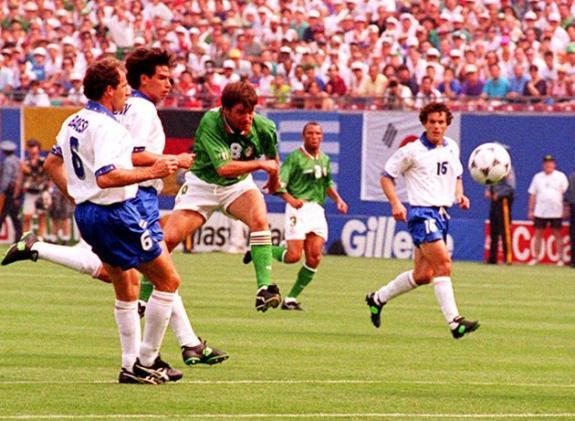
Ireland’s feat, although brilliant, was not that unusual for a World Cup which was strangely exciting. Previously unheralded teams such as Nigeria, Romania and Bulgaria were setting the tournament alight, with the latter teams boasting two of the stars of the competition in the forms of Gheorghe Hagi and Hristo Stoichkov. The football on show was creative and the matches were hard to predict, with shocks being the order of the day. And more bizarrely of all, England’s failure to qualify added to the excitement. For the first time, I could watch a World Cup without any pressure or nerves. I could just sit back and immerse myself in the sporting drama, and it was strangely pleasant.
But by the time of the quarter-finals, the unexpected nature of the World Cup was expected to come to an end, particularly for the clash between the holders Germany and Bulgaria. Although the German squad was aging, with many players past their 1986 and 1990 best, they were still the overwhelming favourites to beat the sparkling Bulgarians. On the day of the game, I was at my Auntie and Uncle’s house for my cousin Nathan’s 12th birthday party, so as we ate copious amounts of sandwiches and jelly and ice cream, and played the obligatory game or two of cricket in the garden, my family were largely ignoring events from New Jersey.
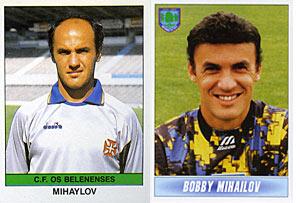
But in the subtle way that these things often happen, by the start of the second half we found ourselves as a family around the TV in the living room, watching the game. One of the major talking points of the tournament had been the somewhat eccentric appearance of some of the Bulgarians. Their goalkeeper, Borislav Mihailov, famously wore a wig, while their defender Trifon Ivanov was nicknamed ‘The Bulgarian Wolf’ for his unkempt beard, greasy-looking mullet and his permanently tired expression which seemed to suggest that he’d spent the last 48 hours on an alcohol binge. There was also a balding central midfielder, Yordan Letchkov, who looked more like a 48-year-old civil servant than a 27-year-old footballer. However distracting these players might have been, though, they still didn’t manage to stop Germany from taking the lead two minutes after half-time. Jürgen Klinsmann found his way into the penalty area and took a typical tumble after a challenge from Letchkov. Yes, he was ever so slightly caught, but his fall was akin to being charged with 4,000 volts. The referee’s decision to award a penalty was greeted with derision by us all.
‘GET UP!!!’ we shouted, but it was to no avail – unsurprisingly, the referee was unable to hear us from across the Atlantic. Lothar Matthäus ignored us too as he stepped up and put the penalty away. Typical Germany – not playing particularly well, but somehow in the lead, and they weren’t going to let it slip now. They never did, especially against underdogs. It was all over surely.
We carried on watching the game, albeit with a little less interest than before. The Germans kept pressing forward, with Andreas Möller hitting the post with an absolute rocket of a shot. The rebound was put in by Rudi Völler, but thankfully – and correctly – he was judged to be offside. Bulgaria were hanging on by their fingernails, Germany had one eye on the semi-finals and we were thinking of going back into the garden again.
But with 15 minutes remaining came a lifeline. Stoichkov tangled with Möller just outside the German box and a free-kick was awarded to Bulgaria. Stoichkov picked himself up and clipped a perfect free-kick into the top left-hand corner, leaving goalkeeper Bodo Illgner stranded. We leapt off the sofa, delighted that the underdogs were back in the game.
Suddenly there was a change. From the restart, Bulgaria smelled a chance and pressed forward. Germany were clearly rattled. We’d never seen them like this before. They were always the master of the comeback – the sign of a truly great side, of course – but now they were giving the ball away and playing well below their own high standards. Bulgaria forced a corner, and from the resulting breakdown, the ball found its way to Zlatko Yankov (no sniggering) on the right-hand side between the edge of the German box and the touchline. He cut inside, wriggled past a challenge from Thomas Berthold and crossed into the penalty area. Enter our friend, the civil servant, Letchkov, who rose like a salmon in front of Thomas Haessler and magnificently smashed a classic diving header past Illgner. Bulgaria had scored twice in three minutes and were 2-1 ahead.

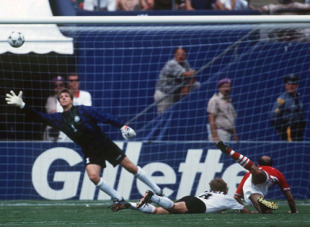
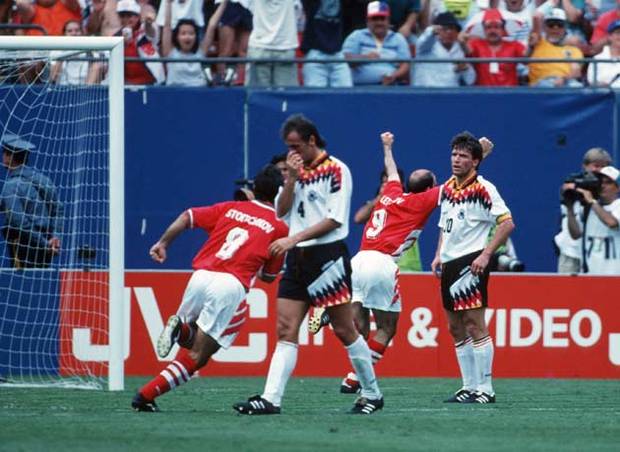
‘LETCHKOV! YES! OH, LOOK AT THIS! THEY’RE IN FRONT!’ screamed John Motson as we danced around our room. We were unable to contain our excitement as we tried to get our heads around what was happening. Germany never went out at the quarter-final stage and had reached the final of three of the past four tournaments (1986 and 1990 World Cup, Euro 88), but now they were just a few minutes away from going out – to Bulgaria. It was incredible, and as the minutes ticked by, we were holding our breath, desperate that our newly adopted country would hold on and cause a massive upset.
And they did it. 13 minutes later, we were dancing around the room again. What a moment it was. Even 20 years later, people still remember that match and particularly Letchkov’s goal. It summed up what was an unexpectedly brilliant World Cup.
As for the romance situation, I never did ask those girls out, although I did become very good friends with Girl 2 over the course of the next 12 months, which only served to complicate matters even more. Unrequited love set to a Britpop soundtrack – fantastic and heartbreaking all at the same time. Ah, they were great days – but I wouldn’t have them back.
 Andy Evans